Israeli Estates Probated Directly in Israeli Courts From New York
Filed with the Israeli Registrar of Inheritances — no separate Israeli attorney required.
What Does It Actually Take to Probate an Estate in Israel From the United States?
Israeli banks and the Israeli Land Registry will not act on a U.S. will alone. That statutory reality surprises almost every family that calls our office.
A parent passes away after living in New York for decades, but they kept an apartment in Tel Aviv and a savings account at Bank Leumi. The family presents a valid U.S. will to the institutions. The bank refuses access. The real estate agent states the apartment cannot be listed until ownership is legally transferred. A relative in Israel mentions the need for a Tzav Kiyum Tzava’a (צו קיום צוואה) — a will validation order — or a Tzav Yerushat (צו ירושה) — an inheritance order. No one in New York knows how to obtain either.
Here is what most families do not realize about cross-border estates: under Section 136 of the Israeli Inheritance Law of 1965, Israeli courts maintain exclusive jurisdiction to adjudicate the estate of any person who resided in Israel at the time of death or who left assets within the country. A New York Surrogate’s Court probate order does not automatically reach across the Atlantic.
To release these assets, you must initiate a separate legal proceeding, filed in Hebrew, with the correct Israeli forum.
Tzav Kiyum Tzava’a: The Israeli court order that validates a deceased person’s will and makes it legally enforceable under Israeli law (the equivalent of probate for a testate estate).
Tzav Yerushat: The Israeli court order that formally identifies the legal heirs of a person who died without a will (the equivalent of letters of administration for an intestate estate).
Both orders are obtained through strict Israeli legal proceedings. Both require specific documentation, and both can be initiated directly from New York — without requiring the family to travel to Israel or retain a separate, secondary attorney overseas.
Why Should You File Directly With the Israeli Registrar of Inheritances?
The difference between coordinating with an overseas attorney and filing directly in Israeli courts is measured in months of delay, thousands in added costs, and the security of knowing exactly who controls the process.
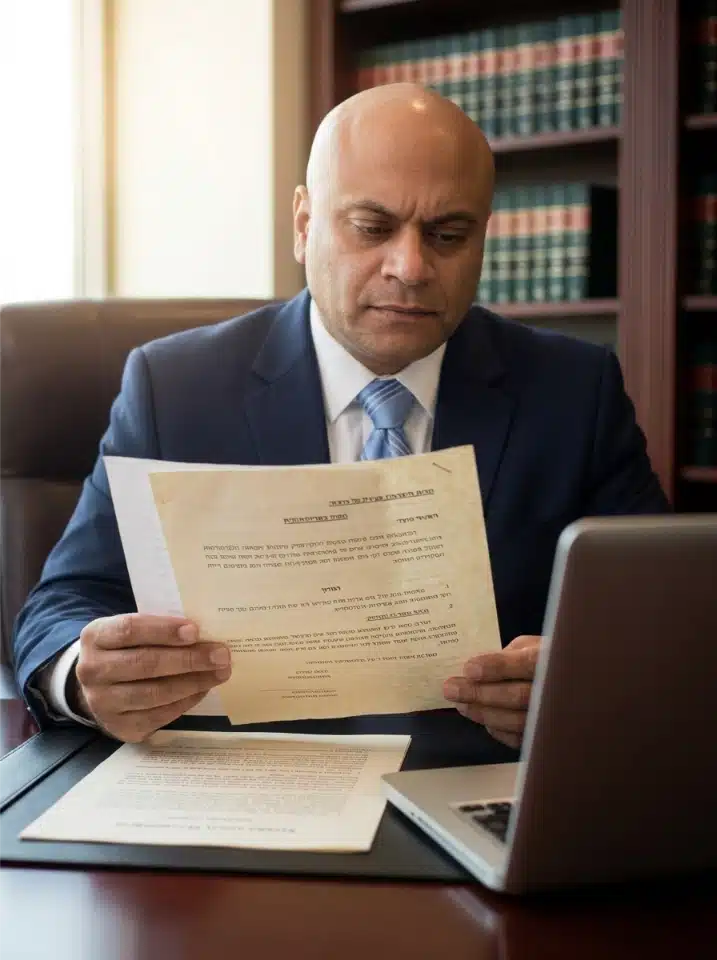
The Law Offices of David Shakarchi has filed directly with the Israeli Registrar of Inheritances (Rasham HaYerushot) and the Israeli Family Court for more than 35 years. This is not a referral practice. Utilizing his dual licensing and bilingual fluency in Hebrew and English, David Shakarchi does not send your case to an Israeli colleague and wait for updates. He files in Israel directly. He communicates with the registrar. He prepares all documentation in Hebrew, strictly adhering to Israeli Succession Law.
The New York metropolitan area is home to one of the largest Israeli-American populations in the world. Across communities in Forest Hills, Rego Park, Kew Gardens Hills, and Teaneck, the same situation repeats: a parent dies with Israeli assets, and the family discovers their regular New York estate attorney cannot handle the Israeli side.
Our 34th Street office in Midtown Manhattan serves as the single coordination point for both the U.S. and Israeli components of these estates. Clients do not manage two attorneys in two time zones. They work with one.
What Happens When an Israeli Bank Account Is Frozen After a Parent Dies?
Straightforward estates — clear heirs, an Israeli will properly executed, and no disputes — can be resolved with the Israeli Registrar in four to six months. Knowing the process before you start it, not after the first filing error, is what keeps a matter on that timeline.
A family in Queens typically calls us six to eight weeks after a death. They have already tried to access the Israeli bank account using a New York probate order, only to have the bank reject it.
The first question we ask is: did your parent have a will that was valid under Israeli law? Under the Israeli Succession Law, a foreign will can be recognized, but only through a highly specific validation process.
If the will meets Israeli validity requirements, we file for a Tzav Kiyum Tzava’a. If the will does not meet those requirements, or if there was no will, we file for a Tzav Yerushat.
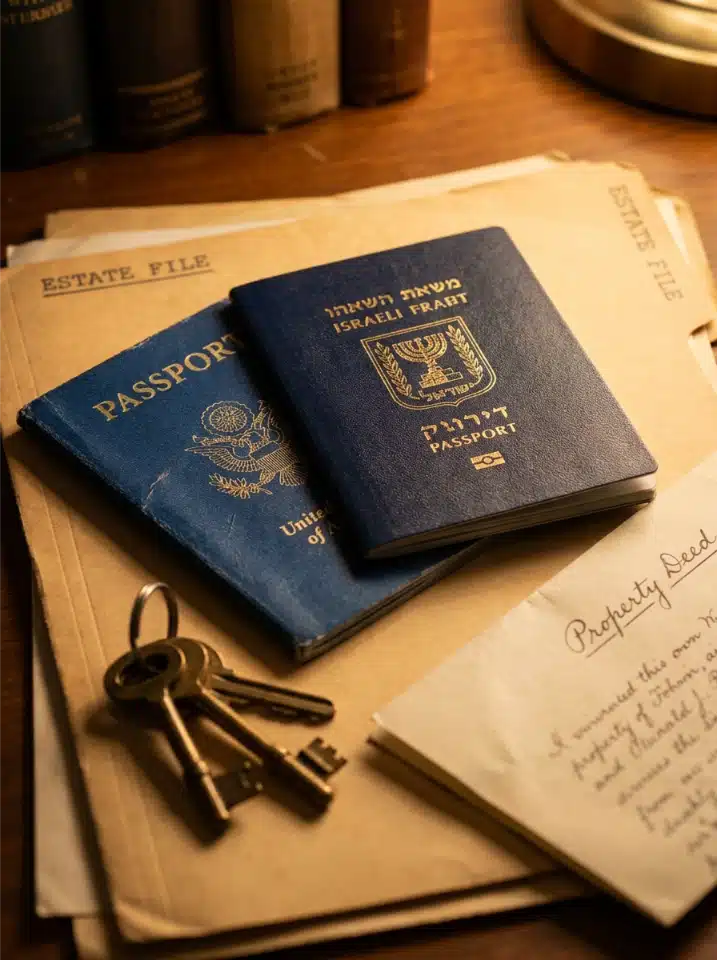
The documentation required for either Israeli order includes certified identification, proof of death, family relationship documentation, and an apostilled U.S. probate order. The apostille is the international document certification required under the Hague Apostille Convention. Getting these documents translated into Hebrew, notarized, and apostilled in the wrong sequence delays the Israeli proceeding significantly.
Will You Need to Hire a Separate Attorney in Israel?
One of the first things families ask is whether they need two attorneys — one in New York, and one in Israel. When you work with this firm, the answer is no.
This firm handles both the U.S. and Israeli sides of a dual-jurisdiction estate under a single representation. This comprehensive approach means:
No time is lost coordinating between U.S. and Israeli counsel.
Document coordination is managed in perfect sequence, so neither country’s proceeding waits on the other.
We have the specialized capability to navigate the procedures for locating unclaimed property within the State of Israel, a common hurdle for heirs of early state investors or those with historical family assets.
How Do We Obtain a Tzav Kiyum Tzava’a or Tzav Yerushat From New York?
Israeli probate follows a rigid sequence that must be executed flawlessly to avoid Registrar delays. Here is how we manage it.
Diagnostics: How Do We Assess the Israeli Estate?
The process begins with a comprehensive review of the estate. We identify the types of Israeli assets involved, including bank accounts, business interests, or real property registered in the Tabu (טאבו) — the Israeli Land Registry.
Crucially, while Section 136 grants the Israeli court jurisdiction, the actual distribution of the property is governed by the inheritance law of the deceased’s country of domicile. This necessitates the presentation of expert legal opinions on New York or New Jersey law to the Israeli courts, which our firm prepares and submits on your behalf.
We also assess your exposure to Mas Shevach (מס שבח) — the Israeli capital gains and appreciation tax. Generally levied at a standard rate of 25 percent on inflation-adjusted net gains, this tax can be severe. For United States beneficiaries of Israeli real estate, we provide a plain-language breakdown of the optimized linear calculation method used for appreciation accrued before and after the 2014 tax reforms. We detail the strict eligibility requirements for the single residential apartment exemption available to foreign residents, and explain the nuanced rules surrounding family property gifts, which can trigger exemptions for the gifter while imposing a reduced Mas Rechisha (purchase tax) on the recipient.
Implementation: How Do We File With the Correct Israeli Forum?
For uncontested estates, we prepare the filing for the Israeli Registrar of Inheritances. The filing includes a petition in Hebrew, supporting affidavits, family tree documentation, and an apostilled, translated copy of the U.S. will. We manage the exact order of operations through the New York Secretary of State: documents must be notarized, apostilled, translated into Hebrew by a certified translator, and then submitted.
Post-Filing: How Do We Release Assets and Update the Tabu?
After the Tzav Kiyum Tzava’a or Tzav Yerushat is issued, the work is not over. We use the court order to actively initiate the release of Israeli bank accounts and transfer real property through the Tabu’s district offices in Tel Aviv, Jerusalem, Haifa, or Beersheba. The Tabu record itself must be explicitly modified.
Registrar of Inheritances or Family Court: How Do We Choose the Right Forum?
The choice between Israel’s two probate forums is one of the most consequential strategic decisions in an Israeli estate.
The Israeli Registrar of Inheritances (Rasham HaYerushot) is an administrative body that processes inheritance orders and will validation orders for uncontested estates. In uncontested cases with pristine documentation, the Registrar can issue an order efficiently within four to eight months.
The Israeli Family Court is the judicial forum that handles contested estate matters, including the complex mechanics of contesting foreign wills. Since 1995, it has held concurrent jurisdiction with the Registrar. Choosing the Family Court is sometimes a strategic necessity — even without an active dispute — because certain complex cases involving missing heirs or intricate international asset structures move faster in a judicial setting.
Timing around the Israeli legal calendar also dictates strategy. Submitting a filing immediately before extended court recesses around Rosh Hashana or Passover can add months to a timeline. We map these variables before we file.

Which Clients Do We Serve Across New York and New Jersey?
This firm serves Israeli-American families throughout the New York metropolitan area navigating complex Israeli estate proceedings from the United States.
We work closely with clients in Manhattan, Queens (including Forest Hills, Rego Park, and Kew Gardens Hills), Brooklyn, the Bronx, and Staten Island, as well as New Jersey communities including Teaneck, Fort Lee, and Englewood.
Clients do not need to fly to Israel. All Israeli filings are managed directly from our Midtown Manhattan office at 1 West 34th Street — exactly one block from Penn Station.
Are You Ready to Begin Your Israeli Estate Proceeding From New York?
Israeli assets only become accessible when the precise Hebrew order is filed in the correct forum in the exact legal sequence.
If a parent or relative has died leaving Israeli bank accounts, real estate, or business interests, call 888-414-6685 or email info@lawpracticeusa.com. We will personally assess the estate, identify the required Israeli court order, and explain the immediate next steps.
You reach David Shakarchi directly — not an intake coordinator.
info@lawpracticeusa.comFrequently Asked Questions About Israeli Probate
How long does it take to get a Tzav Kiyum Tzava’a or Tzav Yerushat from New York?
Uncontested Israeli estates typically resolve in 4 to 8 months through the Registrar of Inheritances. The timeline depends heavily on the district, documentation completeness, and whether all heirs consent. Estates with properly executed Israeli wills and no disputes move faster. Filing in the wrong forum or submitting documents out of sequence can delay the process by several months.
What does Israeli probate cost when handled from New York?
The cost of an Israeli probate proceeding depends on the complexity of the estate, the necessity of drafting expert legal opinions on foreign domicile law, the volume of Hebrew legal translation needed, and whether the matter must be litigated in Israeli Family Court versus processed administratively by the Registrar. David Shakarchi provides a clear, transparent fee structure during the initial consultation once the estate’s asset profile is fully assessed.
Does this firm file directly in Israel, or does it refer to an Israeli attorney?
David Shakarchi files directly with the Israeli Registrar of Inheritances and Israeli Family Court — not through a referral to separate overseas counsel. He is licensed to practice in Israel and has done so for over 35 years, allowing clients to work with a single attorney who manages both the U.S. and Israeli sides of the proceeding from New York.
My parent had a U.S. will — can that be used in Israel without a separate proceeding?
No. A U.S. will is not automatically enforceable in Israel. Under Section 136 of the Israeli Inheritance Law, Israeli banks and the Land Registry require a Tzav Kiyum Tzava’a — a formal Israeli court order validating the foreign will under Israeli Succession Law. That order must be obtained through a separate Israeli legal proceeding before any Israeli assets can be legally transferred.
How do I know whether to file with the Israeli Registrar or Israeli Family Court?
That decision depends on whether the estate is contested and the specific asset types involved. The Registrar handles most uncontested matters and is generally faster. Israeli Family Court is required for contesting wills and is chosen strategically in some complex situations based on district norms. This critical forum selection is made by your attorney at the outset, before any filing is submitted.
What documents do I need to start an Israeli estate proceeding from New York?
Required documents typically include a certified death certificate, proof of heir relationships, and — where a U.S. will is involved — an apostilled and Hebrew-translated copy of that will. The apostille is issued by the New York Secretary of State. Documents must be notarized before the apostille is applied. Submitting them out of this strict sequence causes the Israeli filing to be rejected.